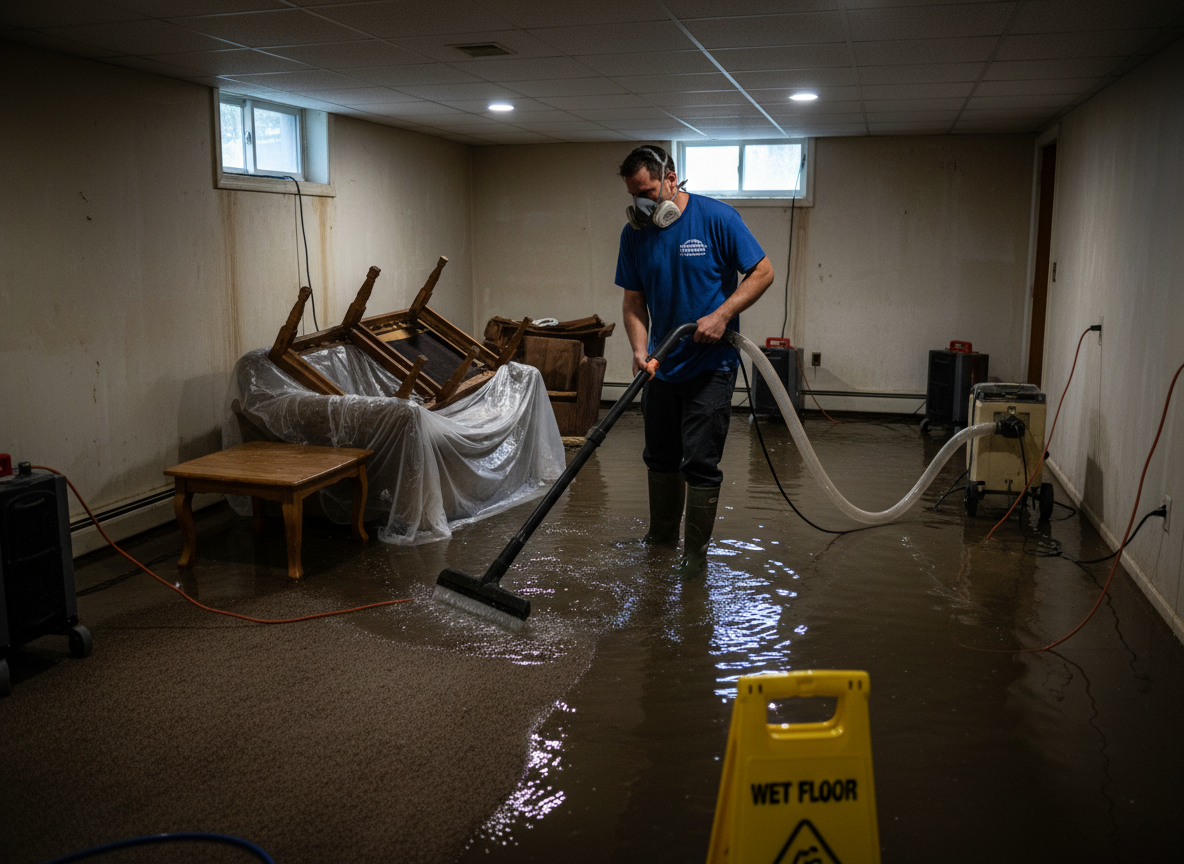
North Hempstead homes often feature older plaster-and-lath construction and finished basements that allow water to travel behind walls and under flooring before it becomes visible. Emergency water removal starts with locating the source and using truck-mounted and portable extractors to pull standing water from carpets, hardwood, and concrete slabs common throughout the area. Technicians then deploy air movers and dehumidifiers sized for the square footage while monitoring moisture levels in subfloors and joists to prevent hidden mold growth.
Local terrain near the Hempstead Plains and proximity to tidal creeks means stormwater can pool quickly around foundations during heavy rains, especially on properties with poor grading. Extraction crews must account for saturated soil against basement walls and the risk of water re-entering through cracks or sump pits. Work proceeds room by room, documenting affected materials so homeowners can coordinate with insurance adjusters familiar with Nassau County claims.
In multi-story homes along Cathedral Avenue and surrounding streets, water from upper-level leaks can migrate downward through HVAC returns and stairwells, requiring extraction on multiple levels simultaneously. Crews use infrared cameras to find moisture pockets in ceilings and behind cabinets that standard fans miss. All removed water is disposed of according to local wastewater guidelines, and equipment is staged to keep noise and power draw manageable during evening hours.
After bulk water is gone, the focus shifts to preventing secondary damage in North Hempstead’s humid summers, where residual moisture can linger in dense hardwood floors or behind tile in older bathrooms. Continuous monitoring with moisture meters continues for several days, and technicians advise on temporary ventilation strategies that respect the tight construction of many pre-war homes.
Technician insight
In North Hempstead, the thing that catches most people out with Emergency Water Removal is how quickly water travels through the plaster-and-lath walls and under old hardwood floors in homes built before 1960; once it reaches the subfloor, extraction alone won’t pull it back out without opening cavities.
Cathedral Avenue Basement Flood
A supply line split behind a finished wall in a 1950s North Hempstead home sent water across the basement slab and into an adjacent storage room. Extraction crews pulled several hundred gallons, opened the lower portion of the affected wall, and ran drying equipment for four days until joist moisture returned to normal. The homeowner avoided full wall replacement by catching the migration early.
Emergency Water Removal Services We Offer
✓Burst Pipe Water Extraction
Immediate removal of water from supply-line failures that commonly affect older copper and galvanized lines in North Hempstead homes.
✓Storm Flood Extraction
Rapid pumping and containment of rainwater that enters through windows, doors, or foundation cracks during heavy Nassau County storms.
✓Appliance Leak Cleanup
Targeted extraction from washing machine, dishwasher, or water heater failures that pool on laundry room or kitchen floors.
✓Sewage Backup Removal
Safe extraction and disinfection of contaminated water from municipal line backups that affect lower-level baths and basements.
✓Roof Leak Water Removal
Extraction of rainwater that enters through damaged shingles or flashing, common on older North Hempstead roofs after winter freeze-thaw cycles.
Emergency Water Removal Cost in North Hempstead, NY
| Service | Typical Range | What Affects It |
|---|---|---|
| Initial Assessment and Containment | Free | Waived when extraction work proceeds |
| Single-Room Extraction | $350–$650 | Varies with water depth and flooring type |
| Multi-Room or Basement Extraction | $800–$1,800 | Includes equipment for several days |
| Sewage-Contaminated Water Removal | $1,200–$2,400 | Requires PPE and disposal handling |
Ranges are typical for North Hempstead, NY and confirmed with an exact written quote before any work starts.
How it works
- 1
On-Site Assessment
Technicians arrive within the service window, locate the water source, and map affected rooms using moisture meters and thermal imaging.
- 2
Water Extraction
Truck-mounted and submersible pumps remove standing water from floors, carpets, and low areas while containing runoff.
- 3
Initial Drying Setup
Air movers and dehumidifiers are positioned based on the home’s layout and construction type to begin moisture removal.
- 4
Daily Monitoring
Return visits check progress with meters and adjust equipment until readings reach acceptable levels for the structure.
Pricing
Cost depends on water volume, number of affected levels, and whether contaminated water is involved.